As I’ve documented throughout my chronic pain experience over the past eleven months, I’ve hit several roadblocks and faced challenges in finding a traditional medical provider who would listen to my concerns and join me in my pursuit uncovering and treating underlying causes or factors.
Enter Holisitic Care: A focus on the whole body, including physical, mental, and spiritual health. With this new approach, I was able to work with my nurse practitioner to create a personalized treatment plan that specifically addressed my unique health needs. In this post, I’ll walk you through my journey–what the tests revealed, how personalized care made all the difference, and the steps I’ll be taking to restore balance in my body.
What is Holistic Care and Why I Chose It
Holistic care is defined as an approach to health and wellness that considers the whole person—mind, body, and spirit—rather than focusing solely on physical symptoms or conditions. It aims to treat the individual as a whole, recognizing the interconnectedness of physical, emotional, social, and spiritual aspects of health. (See my last article on this topic here.)
Assessments and Diagnosis
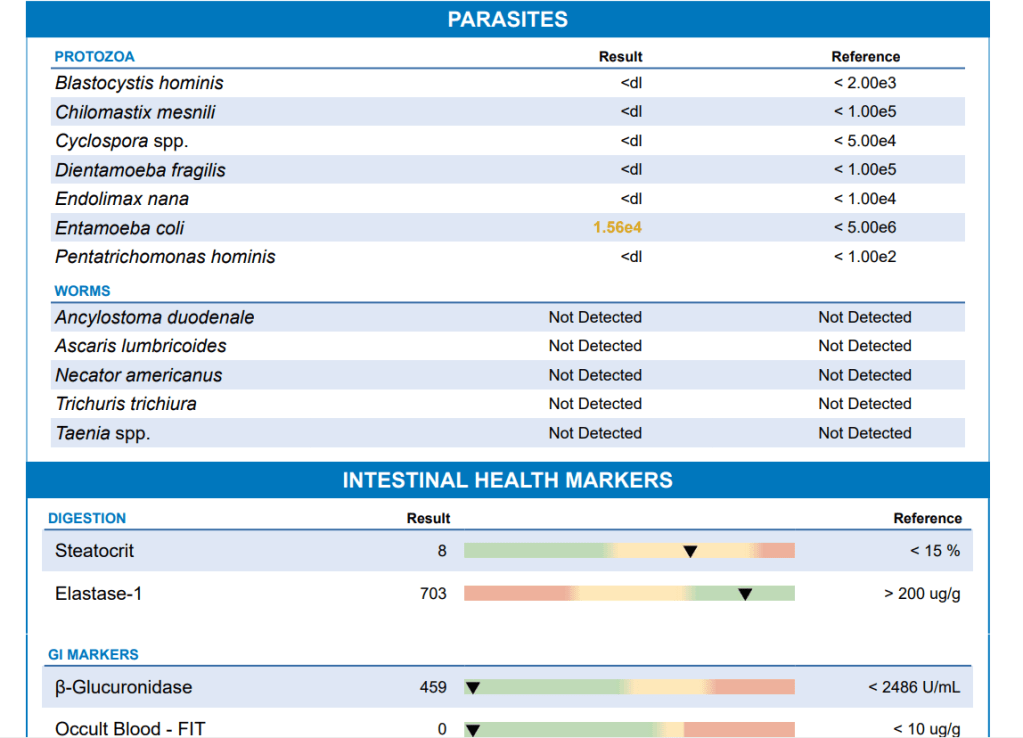
As mentioned previously, holistic care centers around the whole person and is individualized to each patient’s needs. As such, evaluation and assessments will likely differ for each person. However, based on my case history (which was very in-depth and comprehensive), previous medical reports, and symptoms, my nurse practicioner ordered a GI-Map and comprehensive labwork as the first step to determining if, and where an underlying problem may be occuring.
The GI-Map (Gastrointestinal Microbial Assay Profile) test by Diagnostic Solutions Lab is a specialized stool test used to analyze the health and balance of the gut microbiome. It provides a detailed assessment of various microorganisms present in the gastrointestinal system, including bacteria, viruses, fungi, and parasites. The test is often used to help identify gut imbalances, infections, or dysbiosis (an imbalance in the gut microbiota) that may be contributing to digestive symptoms or other health issues.
Though collection of the stool sample was not exactly a pleasant experience, the process organized by the company was efficient. I received a sample box from my NP, which included all materials necessary for collection, forms, packaging, and shipping to the laboratory. All I had to do was call a number provided to schedule pick-up, and someone came to pick up the package from my front door.
Here’s a partial view of my results:
Additionally, my nurse practitioner ordered comprehensive bloodwork (Functional Blood Chemistry Analysis or FBCA) through Evexia Diagnostics. She hand-selected the specific values and measures to inspect. I set an appointment at my local Walgreens for blood collection, where roughly 10 vials were taken (way more than I’ve ever given before)!
FBCA is the process by which blood biomarkers are organized, analyzed, and interpreted. It provides a comprehensive assessment of the body systems and supporting organs, offering more specific details and measures to determine whether your nutrient levels are suboptimal–even though traditional labwork may report “normal”levels because they fall within a wide range.
Here’s a partial view of my results:
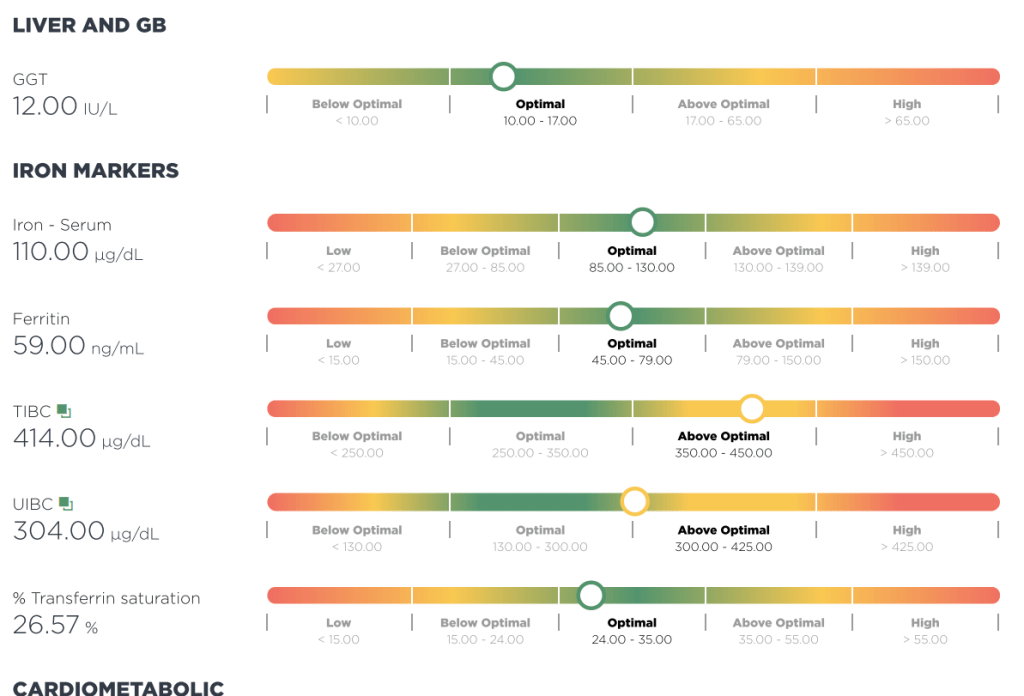
Notice how it provides more specifics. Added benefits include comparative data and analytics. My labwork reviewed the following:
- Blood Glucose
- Metabolic
- Minerals
- Liver and GB
- Iron Markers
- Cardiometabolic
- Thyroid
- Inflammation
- Vitamins
- CBC
- WBCs
Results
“Girl, your gut is a mess!”
This is what my NP said first to me in our lab review appointment. And boy, she was not wrong. The assessments revealed:
- Multiple vitamin deficiencies
- Low akkermanisa (I’ll let you Google that one!)
- Signs of a flared-up and fatigued immune system
- Signs that my body isn’t processing nutrients as it should
- Elevated commensals
- Candida overgrowth
- And, to top it off, A PARASITE!!!! EEEK!
I’ve never thought I’d be so happy to hear all of this. But in researching these deficiencies, overgrowths, and parasites, I’ve developed a new hope that these issues could be the cause or contributing to my pain.
Treatment
So, now that we’ve identified all of these gut-related issues, what’s next?
I will undergo an intensive eight-week gut cleanse. This includes strict dieting, a ton of supplements, and a few medications. The goal is to rebalance the microbiome for optimal gut health, which requires starving the Candida, using binder supplements to reduce the effects of Candida die-off, and restoring healthy bacteria and GI function.
I want to emphasize the importance of medical supervision and guidance to my readers when undergoing assessments and remedies for gut health. Many bacteria, fungi, and parasites that are healthy at certain levels and attemping a gut cleanse without proper guidance can be harmful or even dangerous.
With that said, here is a snapshot of my prescribed supplements and medications:
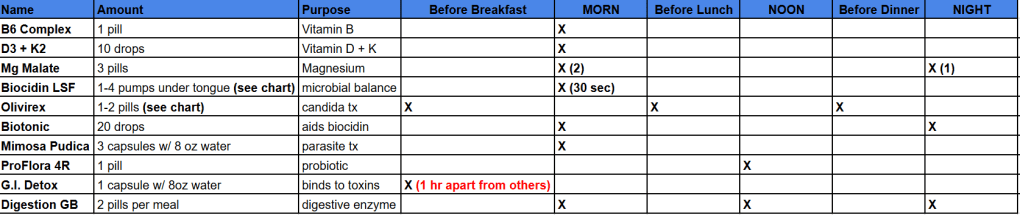
I plan to begin this grueling treatment within the next couple of weeks–once all of the products arrive–and document my experience throughout. Stay tuned!!
My Own Research
Because I love learning about the body and mind, I frequently conduct my own research into topics related to my health. I’d like to share a theory I’ve developed; my gut dysbiosis is the sole cause, or at least a contributing factor to my nerve pain.
(Bringing it back to grad school now…)
The vagus nerve is one of the twelve cranial nerves and is the longest and most complex of them all. It plays a key role in the parasympathetic nervous system, which is responsible for promoting the body’s “rest and digest” functions. The vagus nerve helps regulate a wide range of bodily functions, including heart rate, digestion, respiratory rate, and immune response.
HEAR ME OUT…
In the past several months, I’ve noticed a pattern of flare-ups of nerve pain when my stomach is upset, queasy, or growling for hunger. I recently began taking duloxetine, an antidepressant that targets both depression and nerve pain. It functions by increasing serotonin, and upon taking it routinely, noted a significant reduction in pain–even when my stomach isupset.
I’ve learned that, despite common knowledge, the GI tract is responsible for creating about 90-95% of the body’s serotonin. As proven in my GI-Map and labwork results, my gut has not been functioning adequately for an unknown amount of time. The added serotonin from the medication may be supplementing the lack of serotonin my body produces, thereby reducing the signals my gut sends to my brain (which interprets those signals as pain).
I’ve also observed that when I’ve taken antibiotics over the last year for repeated sinus infections, my pain was significantly reduced. The antibiotics may have started to kill off some of the “icky” parasites and restored some function to my gut for those periods of time.
Interested in learning more? See some articles I’ve found that support the gut-brain connection and the impact of gut health on the peripheral nervous system:
Gut microbiota regulates neuropathic pain: potential mechanisms and therapeutic strategy
Gut microbiota in chronic pain: Novel insights into mechanisms and promising therapeutic strategies
The Gut-Brain Axis: Influence of Microbiota on Mood and Mental Health
In conclusion… this is your sign to get your gut checked!
Follow along as I work to restore my gut health and spread awareness for others:
Follow on Facebook- Painfully Empowered
Additional Resources
 Painfully Empowered
Leave a comment